
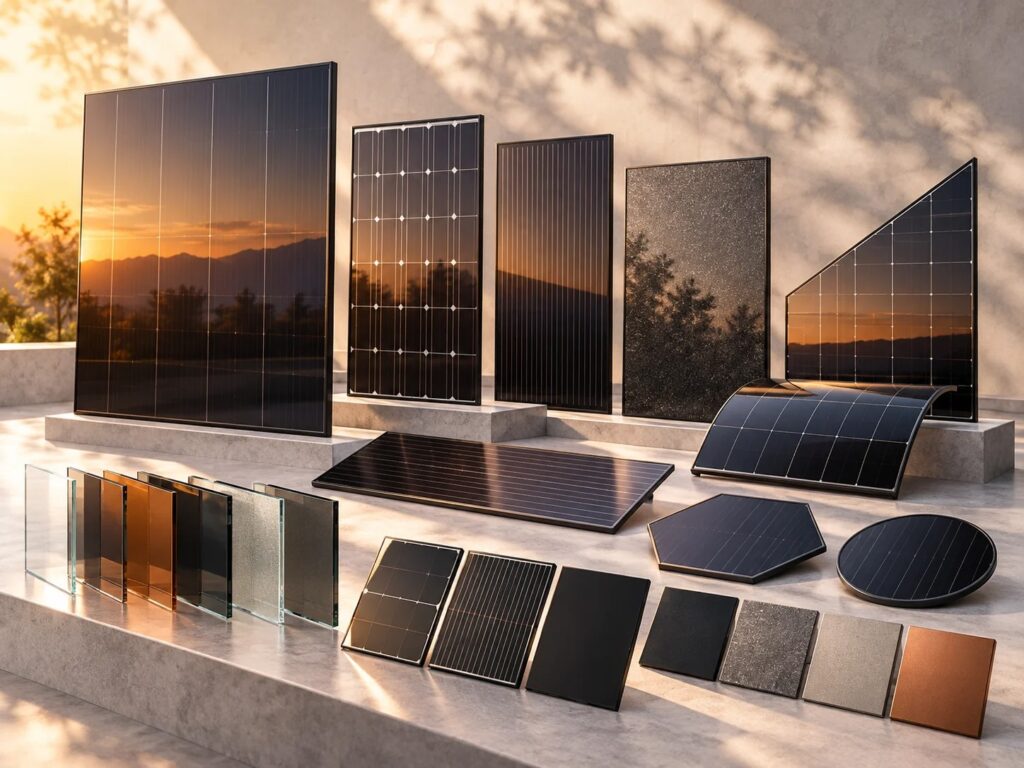
Cover visual: AI-generated concept illustration, not a completed project or certified product.
BIPV CELL TECHNOLOGY
BC vs TOPCon for Custom Building-Integrated Photovoltaic Modules
For an architectural photovoltaic product, cell selection is not simply a contest for the highest headline efficiency. A roofing manufacturer or facade brand needs a module that fits its product geometry, electrical architecture, aesthetic direction, mounting concept and cost targets. Back-contact (BC) and TOPCon are two options worth evaluating, but their suitability is project-specific.
Back-contact cells: appearance and module design
Back-contact technologies place current-collecting contacts on the rear of the cell, which can help create a cleaner front appearance. For premium integrated roofing or facade products, reduced front-side metallization can be attractive. However, total module appearance also depends on cell gaps, interconnection, glass, pigments and the selected cell layout. The interconnection process and module design must be compatible with the chosen BC cell format.
TOPCon cells: available module configurations
TOPCon is a passivated-contact crystalline silicon technology used in a wide range of photovoltaic products. For a custom BIPV module, available cell formats and the proposed wiring arrangement must be checked against the available dimensions. The module manufacturer should evaluate operating voltage, current, cell spacing, interconnection and component supply before selecting a final layout.
What should an OEM team compare?
- Visual appearance: front-side pattern, cell color, borders and interconnection visibility
- Geometry: available cell dimensions and how many cells fit the required module shape
- Electrical match: voltage and current relative to the inverter or module electronics
- Mechanical construction: required glass, encapsulation, edge design and support interfaces
- Supply and cost: cell availability, qualification effort and commercial volumes
Example engineering decision
Consider two custom module concepts with the same external dimensions but different cell layouts. If visual uniformity is critical, one team may evaluate a back-contact arrangement. If wiring, procurement or particular cell-format availability is more important, another arrangement could be more suitable. Neither answer can be generalized without the drawing and electrical targets.
Validation comes after the design
Cell technology alone does not establish module reliability. Encapsulation, insulation, junction box configuration, moisture protection and mechanical design must be validated as a complete assembly. Changes to an existing certified module require assessment of the new construction and applicable standards.
For BIPV product teams
Provide an application drawing, size constraints, target voltage and current, desired appearance and relevant testing markets. For a module manufacturing feasibility discussion, visit FGNEX SOLAR custom BIPV modules or request a technical discussion.