
Made to fit.
Designed to integrate.
Custom BIPV modules begin with your building product. Define the geometry, appearance and electrical design around the roof or facade you are developing.
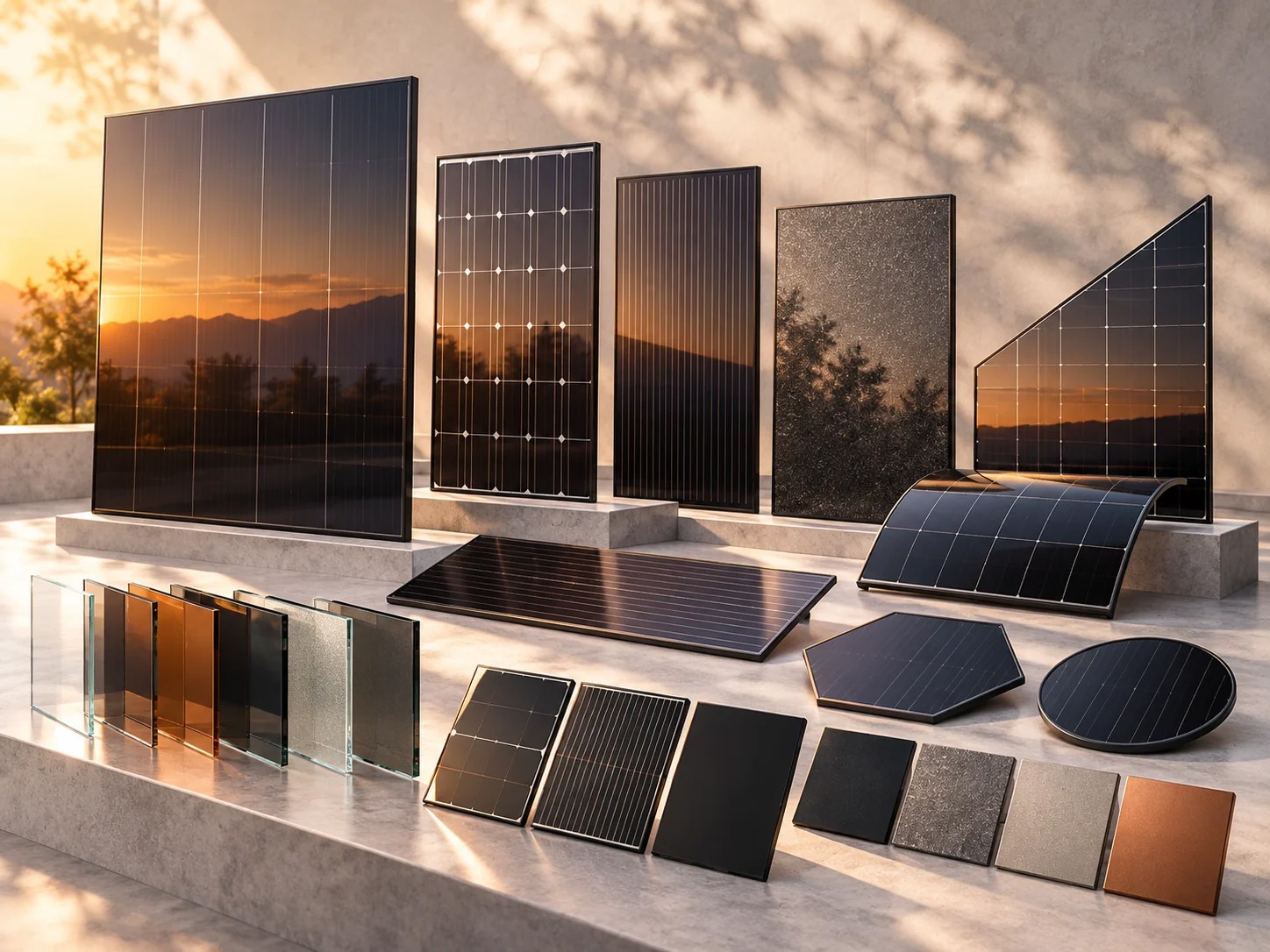
Your system sets the brief.
Explore each customization variable with an illustrative engineering concept. Options must be reviewed together against your final module design.

Custom Dimensions & Shapes
Define external dimensions, shape, edge clearances, glass thickness and tolerances around the building interface. Non-standard formats require a feasibility review before a manufacturing commitment.

BC / TOPCon Cell Technology
Compare back-contact and TOPCon options against visual appearance, available cell formats, interconnection routes and electrical targets. Cell technology is selected for the complete module design.

Custom Cell Arrangement
Explore cell count, spacing, orientation and visible borders within the available geometry. Coordinate the layout with shading, wiring and architectural intent.

Glass-Glass Construction & Appearance
Specify front and rear glass, surface treatment, color and desired transparency. Review visual samples together with mechanical support and safety requirements.

POE Encapsulation & Butyl Edge Sealing
Evaluate POE encapsulation and butyl edge sealing for compatibility with the selected glass, cells and lamination process. Material choice alone does not establish durability.

Junction Boxes, Cables & Connectors
Define box position, rear clearance, cable length, cable cross-section and connector family. Confirm electrical compatibility and accessible routing within the building assembly.

Electrical Configuration
Set target voltage, current, rated power and bypass requirements. Review series and parallel layouts, insulation and compatibility with the intended inverter or module electronics.

Prototype Development & OEM Validation
Agree drawings, samples, test scope, quality checkpoints and change control before production planning. Quantities, lead times and qualification requirements are confirmed for each project.
From building detail to validated module.
Share the application
Provide preliminary drawings, target markets, quantities and the building-system interfaces.
Resolve the design
Review cell layout, glass, sealing, electrical architecture and installation clearances.
Evaluate prototypes
Assess samples, visual consistency, test needs and design revisions against the agreed brief.
Plan OEM supply
Agree approved specifications, quality checks and commercial terms before production.
Bring your next BIPV product into focus.
Start with the application, a preliminary drawing and your target electrical characteristics. FGNEX SOLAR reviews manufacturing enquiries for project-specific feasibility.
Visuals illustrate design directions, not a product catalogue, completed project or certification. Manufacturing limits, minimum order quantities, performance and qualification must be confirmed for the proposed design.